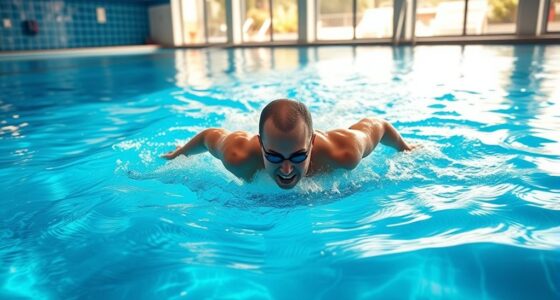
To start deep-water running, you’ll need a flotation belt for support and comfortable swimwear. Focus on maintaining a tall posture with your pelvis and spine neutral, engaging your core for stability. Move your legs with controlled, wide-back angles and lift your knees high, while coordinating your arm swings opposite your legs. Keep your feet relaxed and hands cupped lightly. Gradually, you’ll discover effective techniques that make your workout both safe and productive—if you keep exploring further, you’ll uncover even more tips.
Key Takeaways
- Use a flotation belt to support your body and maintain proper posture in deep water.
- Focus on controlled, rhythmic arm and leg movements to mimic running efficiently.
- Engage your core muscles to stabilize your spine and improve movement stability.
- Start with warm-up and cool-down periods to prevent fatigue and injury.
- Incorporate intervals and resistance tools gradually to enhance strength and cardiovascular benefits.
Essential Equipment for Deep-Water Running

To get the most out of deep-water running, you’ll need essential equipment that supports safety, comfort, and effective workouts. Flotation belts, like the Aqua Jogger Belt, are vital for buoyancy, keeping you suspended so your feet don’t touch the pool bottom. These belts are made of soft foam with adjustable buckles, ensuring a secure fit around your waist. Properly fitted belts support your core, help you maintain an upright posture, and allow free arm and leg movement. Investing around $60 for a quality belt means durability for regular use. Additionally, good swimwear, such as a one-piece or trunks, reduces drag and increases mobility. Optional accessories like swim caps and goggles can enhance comfort, especially during outdoor sessions. Water resistance helps build strength while minimizing joint stress during high-impact activities. Incorporating the correct aquatic gear ensures a safer and more effective deep-water running experience.
Proper Posture and Body Alignment

Maintaining proper posture and body alignment during deep-water running guarantees you move efficiently and reduce the risk of injury. Keep your pelvis and spine in a neutral position, avoiding tilts forward or backward. Engage your core muscles to support your spine and prevent slouching or arching, which can cause strain. Maintain an upright, straight upper body rather than leaning forward, as excessive lean strains muscles and compromises form. Proper alignment helps you stay stable in the water, facilitating effective forward propulsion. Keep your head aligned with your spine, eyes slightly forward, and relax your neck muscles. Use a controlled, short stride, driving your feet downward and backward. Avoid locking your knees and overextending, focusing instead on smooth, efficient movement that supports your posture and stability. Good posture also enhances breathing efficiency, allowing you to sustain your workout without unnecessary fatigue.
Techniques for Effective Leg Movement

Effective leg movement in deep-water running relies on proper positioning and controlled motion. You should focus on a wider backward leg angle to counter water resistance, with exaggerated knee lifts to maintain propulsion. Keep your feet relaxed and flexed upward during recovery to catch water efficiently. Your stride involves sweeping your leg back and downward with controlled, rhythmic lifts, avoiding unnecessary vertical motion. To visualize this, see the table:
| Aspect | Technique | Purpose |
|---|---|---|
| Knee Lift | Lift knees high over obstacles | Strengthen quads, hamstrings |
| Foot Shape | Keep feet flexed upward during recovery | Maximize water catch |
| Leg Push | Push water backward with controlled force | Propel forward efficiently |
Mastering these techniques ensures effective propulsion, stability, and energy conservation in your deep-water run. Proper body positioning also plays a crucial role in optimizing your movement and reducing fatigue during exercise.
Coordinating Arm Motion With Legs
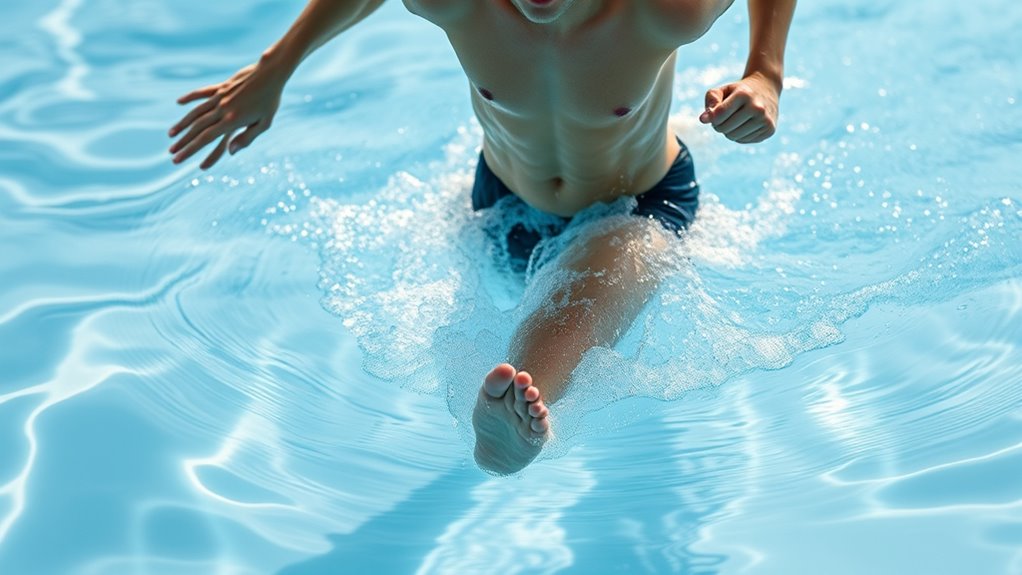
To run efficiently in water, you need to coordinate your arm and leg movements seamlessly. Each arm swing should match the opposite leg drive, helping propel your body forward with less effort. Proper timing and technique maximize your workout and keep your posture upright. Maintaining a synchronized rhythm between arm and leg movements is essential for reducing fatigue and improving overall efficiency. Developing a consistent movement pattern ensures that your muscles work harmoniously, making your water running more effective and less tiring.
Synchronizing Arm and Leg Movements
Synchronizing arm and leg movements is essential for achieving a natural, efficient running rhythm in deep water. When your arm swings match your backward leg drive, your motion becomes fluid, boosting both form and endurance. Focus on driving one knee up while pushing the opposite foot back, with your arms swinging in opposition to stabilize your posture. Keep a steady rhythm by using a focal point ahead and monitoring your turnover rate. As you increase speed, maintaining this coordination prevents energy waste and reduces fatigue. Water resistance challenges your muscles, so smooth, synchronized movements help you overcome drag efficiently. Incorporating drills and interval training to refine your timing makes your deep-water runs more effective and comfortable, while strengthening your neuromuscular patterns. Proper technique not only enhances performance but also minimizes the risk of injuries caused by awkward or inefficient motions. Additionally, developing muscle memory through consistent practice ensures your movements remain fluid and natural over time.
Maintaining Proper Arm Technique
Maintaining proper arm technique in deep-water running is essential for balancing your movements and maximizing efficiency. Keep your arms close to your body, moving in a natural running motion. Relax your shoulders, keeping them back to avoid tension, and bend your elbows at about 90 degrees, just like on land. Your hands should stay relaxed, not clenched, to prevent fatigue. Focus on vigorous arm pumping, driving forward and backward in sync with your legs. Coordinate your arm swing with the opposite leg to maintain balance and propulsion. Use full range of motion, pushing water behind you to generate forward momentum. Avoid stiff or overly stiff arms, and don’t let your arms drift away from your sides. Proper technique helps improve workout effectiveness and keeps you upright and balanced. Understanding the importance of psychological assessment can also contribute to a more effective training approach, as mental focus and self-awareness are key components of athletic performance.
Maintaining Relaxed Feet and Hands
Keeping your feet and hands relaxed is essential for efficient deep-water running. Relaxed feet help maintain a natural foot position, allowing you to slice through the water smoothly instead of pushing against resistance. Avoid pointing your toes rigidly up or down; instead, keep them gentle and flexible. Your hands should start by cupping the water lightly for balance, then shift to relaxed fists or slicing motions. Tension in your extremities causes unnecessary fatigue and reduces efficiency. Relaxation in your hands and feet promotes fluid movement and minimizes muscular strain. Focus on gentle, rhythmic foot dorsiflexion and plantarflexion, and keep your arms bent at about 90 degrees with relaxed hands. This approach improves propulsion, conserves energy, and supports better posture during your workout. Additionally, understanding the importance of proper technology such as high-quality projectors can enhance your overall experience.
Engaging Core Muscles for Stability

Water’s natural resistance actively engages your core muscles during deep-water running, forcing them to work continuously to keep your body upright and stable. This resistance activates your abdominal, oblique, and lower back muscles, helping you maintain proper posture. Since there’s no ground to rely on, your core must stabilize every movement—arm swings, leg drives, or progressions—making your muscles work harder than on land. The deeper the water, the greater the challenge to your stabilizers, as balance relies solely on your core strength. Using equipment like flotation belts or resistance tools further amplifies this engagement. Research shows that core activation during aquatic exercise significantly improves overall stability. Consistently activating your core not only improves posture and reduces injury risk but also enhances endurance and functional strength, benefiting daily activities and athletic performance.
Designing Your First Workout Session

Start your workout with a 5-10 minute warm-up to prepare your muscles and joints, then structure your main session with intervals or steady effort based on your fitness level. Make sure to include a cool-down of similar duration to gradually lower your heart rate and promote recovery. Pay attention to pacing, alternating between moderate and hard efforts, and adjust as you become more comfortable. Incorporating resistance tools like bungee cords can help elevate your heart rate and add variety to your workout. Additionally, understanding how Ford Tuning can optimize engine performance may inspire you to approach your training with a mindset of continuous improvement.
Warm-up and Cool-down
Before diving into your deep-water running session, it’s essential to include a warm-up to prepare your body for exercise. Spend 5 to 10 minutes gradually increasing your activity level with water walking or jogging in chest-deep water. Incorporate high knee jogging to activate your hips and glutes, and high heel jogging to stretch your quadriceps. Engage your upper body with arm swings and sweeps to improve coordination. Focus on maintaining an upright posture, pushing water behind with your arms, and controlling your movements. Use water resistance to boost muscle activation and gradually raise your intensity from easy to moderate. A proper warm-up reduces injury risk, enhances blood flow, and helps you adjust to the water environment, setting a solid foundation for your workout. Additionally, incorporating low-impact cardio exercises like water marching or aqua jumping jacks can further enhance your warm-up, promoting better circulation and joint mobility. For optimal results, consider understanding optimal angles for pinball machines to improve your overall performance and engagement.
Interval Structure and Pacing
Designing your first deep-water running workout involves selecting appropriate interval types, durations, and pacing to match your fitness level. Start with aerobic intervals: 2-minute efforts at RPE 6-7, with equal active recovery, ideal for beginners. Incorporate 1-2 short high-intensity sprints of 30-45 seconds with decreasing rest periods from 90 seconds to 30 seconds to boost power. Use pyramid or fartlek structures to vary intensity and duration, challenging your endurance without overexertion. Maintain proper pacing by monitoring your RPE scale, aiming for 87-92% max heart rate during moderate efforts and pushing closer to 95-100% during sprints. Finish with a cool-down at an easy pace. Adjust interval length and intensity gradually to build endurance safely while minimizing fatigue. Incorporating proper pacing ensures you stay within safe exertion levels and maximize workout benefits.
Common Challenges and How to Overcome Them

Deep-water running presents unique challenges that can hinder your progress if not addressed properly. Maintaining balance requires a well-fitted flotation belt to keep your head above water and prevent excessive sideways kicking. Without support, you might tread water instead of running, losing form and efficiency. Adjusting to zero ground contact can feel disorienting at first, so focus on natural hip flexion and leg turnover to mimic land running. Overreliance on arm movements, like cupping water, can disrupt your flow and cause fatigue. Muscle fatigue is common because water resistance increases workload, especially for the posterior chain. To avoid injury, progress gradually, monitor effort, and use proper equipment like flotation belts and water shoes. Proper mechanics are crucial in deep water running to prevent bad habits, as developing correct form early will lead to more effective workouts and reduce the risk of injury. Additionally, paying attention to proper technique can help you adapt more efficiently and maximize your training benefits over time.
Tips to Build Confidence and Improve Technique

Building confidence and refining your technique in deep-water running starts with mastering foundational movements and maintaining proper posture. Keep your body upright with shoulders relaxed and back, engaging your core without tensing. Pump your arms at 90 degrees, using water resistance to propel yourself forward and stay balanced. Focus on driving your knees in a circular, windmill motion, sweeping your legs back for full muscle engagement. Point your toes slightly forward to increase resistance and mimic a natural stride. Avoid leaning forward excessively; instead, stay vertically aligned to prevent strain and maximize effort. Start with short, controlled sessions to build endurance, gradually increasing duration and intensity. Use tools like flotation belts and resistance gear to enhance stability and strength. Celebrate small wins to boost confidence and stay motivated. Proper equipment supports safety and effective workouts, helping you maintain correct form and prevent injury.
Safety and Precautions for Beginners
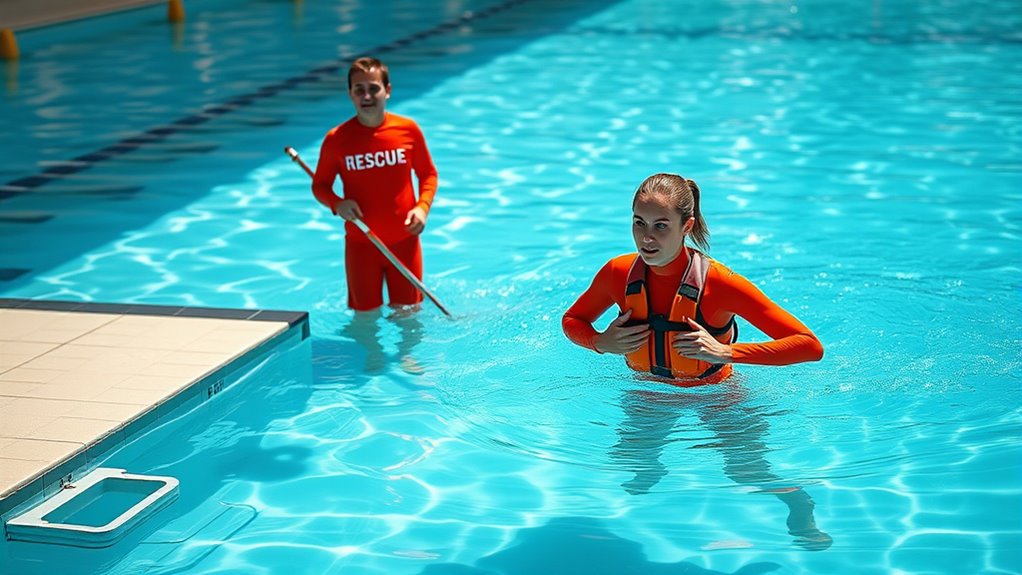
Ensuring safety in deep-water running is essential, especially for beginners. You need to be aware of potential hazards and take precautions to prevent injuries. Here are three key safety tips:
- Use a high-quality flotation belt to maintain proper body position, reduce fatigue, and support neutral buoyancy. Proper flotation is crucial for optimal technique and safety.
- Wear water shoes for better traction and foot protection against slippery or rough surfaces.
- Check that the pool area is free of hazards, with sufficient depth (around 5-6 feet), clear water, and easy access points. Confirm the presence of a lifeguard or supervisor for added safety.
Additionally, perform a warm-up, monitor your physical signals, and practice in shallow water before progressing. These precautions help create a safe, effective deep-water running experience. Water’s buoyancy allows for a full range of motion and supports proper technique, reducing the risk of overexertion or injury.
Frequently Asked Questions
How Often Should Beginners Practice Deep-Water Running Weekly?
You should practice deep-water running 2 to 3 times a week initially. This frequency gives your body enough time to adapt and recover. As you build endurance and improve technique, gradually increase to 4 or 5 sessions per week. Remember, rest days are essential for muscle recovery, and starting conservatively helps prevent injuries. Listen to your body and adjust your schedule based on your fitness level and progress.
Can Deep-Water Running Replace Land Running for Training Purposes?
Yes, deep-water running can replace land running for training, especially if you’re looking to maintain cardiovascular fitness while reducing impact on your joints. It simulates land running closely, activating similar muscles and boosting your VO2max. Plus, water resistance makes it more challenging, and it’s ideal during injury recovery or cross-training. However, for peak performance, consider combining both methods over time, as each offers unique benefits.
What Are Signs of Overexertion During Deep-Water Running?
During deep-water running, you’ll notice overexertion if your heart rate exceeds target zones, you feel breathless or irregular, or muscle fatigue causes burning or trembling. Dizziness, excessive sweating, sharp pain, cramps, or stiffness also signal you’re pushing too hard. Behavioral signs like declining cadence, uncoordinated movements, or mental fog indicate fatigue. If you experience dehydration, headache, or difficulty maintaining posture, it’s time to slow down or rest immediately to prevent injury.
How Can I Improve My Deep-Water Running Form Quickly?
Imagine your perfect running form as a guiding star; to reach it quickly, focus on maintaining upright posture with shoulders back, core engaged, and relaxed neck and shoulders. Pump your arms vigorously at 90 degrees, drive your knees upward, and extend your stride fully. Incorporate interval drills, stay mindful of your body alignment, and regularly check your form. Consistent practice transforms good intentions into smooth, efficient deep-water running.
Is Deep-Water Running Suitable for All Fitness Levels and Ages?
Yes, deep-water running suits all fitness levels and ages. You can adjust the pace and duration to match your ability, making it low-impact and safe for recovery or joint issues. Whether you’re young or elderly, water’s buoyancy reduces stress on joints while providing a full-body workout. Just guarantee you have proper equipment, start slowly, and consult your doctor if needed. This way, you can enjoy the benefits safely.
Conclusion
Now that you know the essentials of deep-water running, you’re ready to plunge in and transform your fitness journey. With proper technique and confidence, you’ll feel unstoppable—like a powerhouse gliding effortlessly through water. Remember to stay relaxed, follow safety tips, and keep pushing your limits. Before long, you’ll be mastering this low-impact, high-intensity workout and reaping incredible results. Get ready to crush your goals and make waves in your fitness adventure!