
To understand water park weather forecasts, focus on key details like temperature, rainfall, wind speed, and cloud coverage, which determine your plans for rides and safety. Pay attention to short-term updates for immediate changes and look at medium or long-range outlooks for upcoming days or weeks. Probabilities indicate the likelihood of rain or storms, helping you prepare accordingly. Curious about how to interpret these forecasts more effectively? Keep reading to uncover expert tips and techniques.
Key Takeaways
- Understand forecast types like short-term, radar-based, and computer models to interpret specific weather predictions.
- Check detailed data such as temperature, rain probability, wind speed, and humidity for operational planning.
- Recognize probability indicators (e.g., 30% chance of rain) to gauge forecast confidence and coverage.
- Use real-time data sources and automated alerts for quick response to changing weather conditions.
- Consider long-range and trend forecasts to prepare for seasonal patterns and ensure guest safety.

VEVOR YT60234 WiFi Weather Station 7-in-1, Weather Stations WiFi Indoor Outdoor, 7.5" Color Display for Weather Forecast, Temperature, Humidity, UV, Air Pressure, Wind Speed&Direction, Rain, Alarm
7-in-1 Sensor: Our Wi-Fi weather station provides precise monitoring of wind speed, wind direction, temperature, humidity, rainfall, light,…
As an affiliate, we earn on qualifying purchases.
As an affiliate, we earn on qualifying purchases.
Understanding the Types of Weather Forecasts for Water Parks

Understanding the different types of weather forecasts for water parks helps you plan your visit more effectively. Short-term forecasts, like hourly or daily updates, give you immediate information on temperature, rain chances, and wind, helping you decide if it’s safe to go or if you should bring extra gear. Radar-based forecasts track precipitation movement and intensity, so you can anticipate sudden storms or rain showers. Computer models simulate atmospheric conditions to predict weather more accurately over the coming hours or days, often combining local observations. Wind and cloud patterns, such as shifting wind directions and cloud formations, can provide additional clues about approaching weather, enabling you to make more informed decisions. Additionally, understanding forecast accuracy helps you assess how much trust to place in different predictions, especially when planning outdoor activities. Special forecasts, like “feels like” temperature, account for humidity and wind, which influence your comfort and safety. By understanding these forecast types, you can better prepare for weather changes and make the most of your water park experience.

APEXUP Packable Rain Jacket Men with Reflective Zipper, Lightweight Waterproof Jacket Windbreaker Hooded Raincoat, Mens Rain Jackets for Outdoor, Running, Hiking, Travel, Cycling (Fluo Green, L)
Waterproof and Windproof: APEXUP men's rain jacket is made from tear-resistant, high-density polyester with waterproof zippers; It features…
As an affiliate, we earn on qualifying purchases.
As an affiliate, we earn on qualifying purchases.
Key Meteorological Parameters to Watch
Monitoring key meteorological parameters is essential for ensuring safety and guest comfort at water parks. Precipitation levels, including rainfall amount and timing, directly affect ride operations and safety. Heavy rain can lead to ride closures or evacuations, while prolonged drizzle impacts guest experience. Snowmelt runoff is relevant for seasonal parks, influencing water flow and attraction safety. Data analysis and predictive modeling support better decision-making in water park management. Probability of precipitation helps you anticipate rain, guiding staffing and guest advisories. Precipitation type, like hail or sleet, determines impact severity, with hail posing physical hazards. Air temperature influences guest comfort and water temperature, while apparent temperature accounts for humidity-related discomfort. Wind speed and direction affect wave generation and debris movement, and humidity levels impact guest comfort and surface safety. Tracking these parameters helps you plan and respond effectively. Advanced forecasting techniques have enhanced the accuracy of short-term weather predictions, enabling better planning for water park operations.

FosPower NOAA Emergency Weather Radio A1 7400mWh Portable Power Bank, AM/FM, USB/Solar/Hand Crank Charging, Battery Operated, SOS Alarm & Flashlight for Indoor/Outdoor Emergency – Orange
[7400mWh (2000mAh) POWER BANK WILL KEEP DEVICES POWERED] The FosPower FOSPWB-2376 emergency radio incorporates a 7400mWh (2000mAh) power…
As an affiliate, we earn on qualifying purchases.
As an affiliate, we earn on qualifying purchases.
How Weather Data Is Collected and Measured
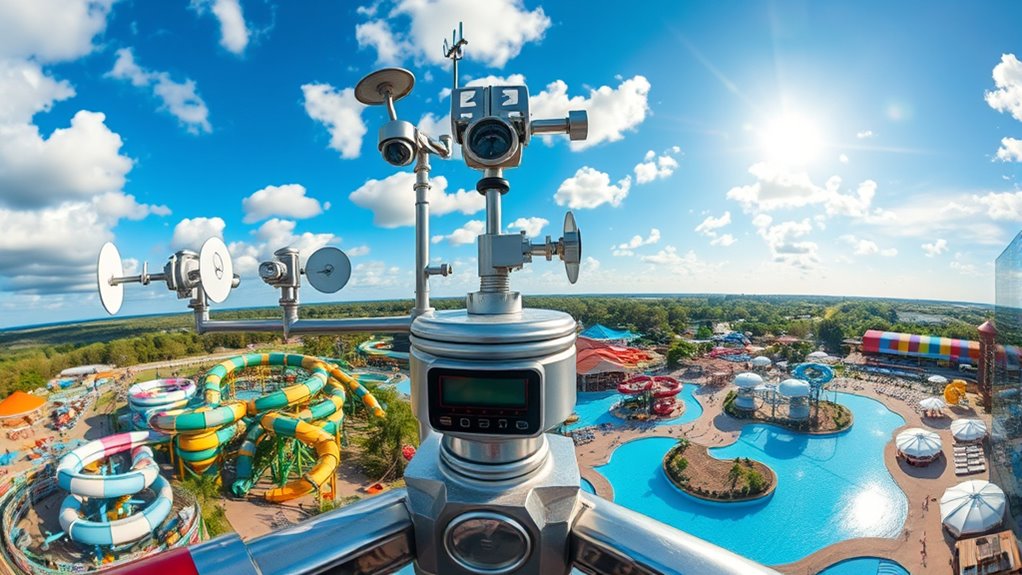
Weather data collection relies on a variety of instruments and sources, like satellites, radar systems, and ground stations, to gather real-time atmospheric information. Emerging technologies, such as machine learning and advanced sensors, are improving the accuracy and speed of data measurement. Understanding how these tools work helps you better interpret water park weather forecasts and plan your visit. AI-driven models, trained on decades of open-source weather data, are now complementing traditional methods to provide more timely and localized forecasts. Additionally, ongoing research into AI detection methods enhances the ability to identify and predict extreme weather events more accurately.
Measurement Instruments Used
Measurement instruments are essential for collecting accurate weather data that influence water park operations and safety. Thermometers measure air and surface temperatures with mercury, alcohol, or digital sensors, providing readings in Celsius or Fahrenheit. Infrared thermometers allow you to take quick, non-contact temperature measurements by sensing emitted radiation. Some thermometers track temperature extremes over time with max/min recorders. Barometers measure atmospheric pressure, indicating weather changes; mercury and digital types help forecast storms and high winds. Hygrometers assess humidity levels, which affect precipitation and comfort. Anemometers gauge wind speed, while wind vanes indicate wind direction, both critical for safety. Rain gauges record precipitation amounts, essential for flood prevention. These instruments also provide data for weather forecasting models, helping predict future conditions. Additionally, accurate data from these tools can inform water park scheduling and emergency procedures. These instruments deliver precise data needed for safe and efficient water park operations.
Data Collection Sources
To gather accurate weather data near water parks, various sources deploy specialized instruments and networks that capture local atmospheric conditions. Meteorological stations near water bodies, like riparian stations, use sensors to measure variables such as radiation at water surfaces and atmospheric factors, often sharing data through open portals. Surface observation networks, including land stations, buoys, ships, and aircraft, collect data on temperature, humidity, wind, pressure, and precipitation, with automated systems providing real-time updates. Precipitation measurement techniques include rain gauges for liquid and snow, complemented by Doppler radar, which estimates rainfall intensity and distribution, enhancing regional accuracy. These diverse data sources provide comprehensive coverage essential for accurate weather forecasting and monitoring. Additionally, data integration systems combine information from multiple sources to improve forecast precision and reliability. Remote sensing instruments like weather satellites and radar systems observe cloud cover, temperature, and moisture over large areas. All these sources feed into automated systems for detailed weather data collection.
Emerging Technologies Applied
Emerging technologies like artificial intelligence (AI), machine learning, high-resolution modeling, and advanced radar systems are revolutionizing how weather data is collected and measured for water parks. AI tools like HydroForecast combine satellite imagery with weather forecasts to deliver real-time predictions of streamflow and precipitation. Machine learning models such as Latent-EnSF improve data assimilation, offering faster, more accurate medium-range forecasts, even during extreme or missing data scenarios. High-resolution weather models, enhanced by drone data, provide detailed local forecasts down to 1 km, capturing microclimates around water parks. These innovations leverage cutting-edge technology enable water parks to anticipate weather changes with greater precision, ensuring safer, more efficient operations. Additionally, the integration of real-time data collection systems allows for continuous monitoring, further enhancing predictive accuracy and operational responsiveness. Advanced radar systems like X-Band radars detect localized storms and precipitation, supporting flood management and safety protocols.

Wondery USA® National Parks Water Bottle With 63 Waterproof Stickers of Parks (USA), 32 oz Stainless Steel Water Bottle for Traveling, Hiking, Camping, National Park Gifts – OCEAN
We made the ORIGINAL National Parks bottle and sticker concept back in 2020, and we give back to…
As an affiliate, we earn on qualifying purchases.
As an affiliate, we earn on qualifying purchases.
The Role of AI and Machine Learning in Forecasting
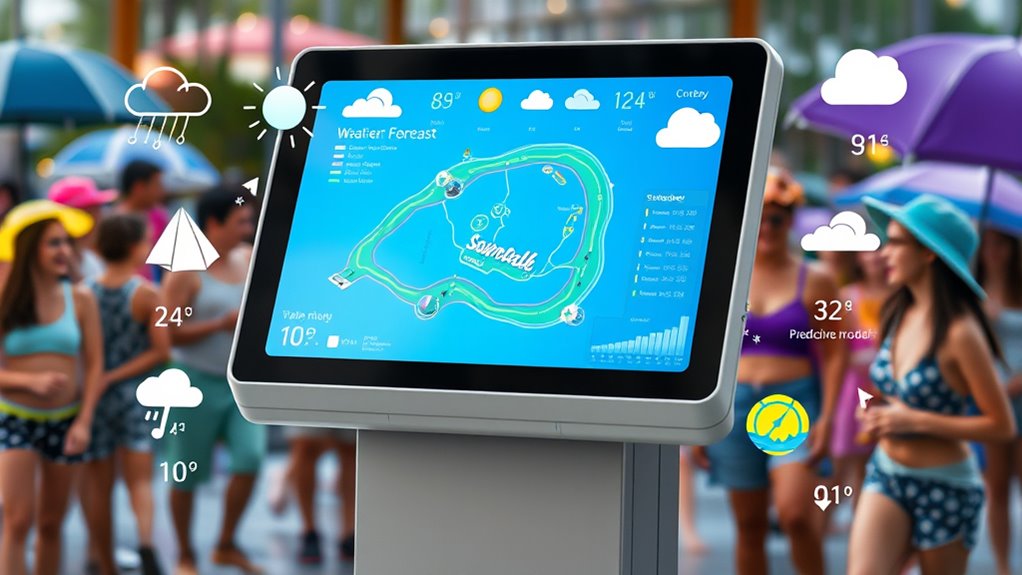
AI and machine learning are transforming weather forecasting by enabling faster and more accurate predictions. They process real-time data from radars, satellites, and weather stations more quickly than traditional models, improving forecast reliability. Advanced AI techniques like Latent-EnSF enhance data assimilation, especially with sparse datasets, making predictions more precise. Deep learning algorithms recognize complex weather patterns and non-linear relationships, continuously adapting as new data arrives. These models excel in nowcasting, providing rapid warnings for thunderstorms, floods, and other severe events, outperforming conventional methods. Hybrid systems combine AI with physics-based models for better accuracy, while fully data-driven models generate quick, reliable forecasts with less computational power. Additionally, understanding cookie categories helps improve user experience and data accuracy in digital tools. Overall, AI and machine learning substantially upgrade our ability to predict and respond to water park weather conditions.
Interpreting Probabilities and Uncertainty in Weather Predictions
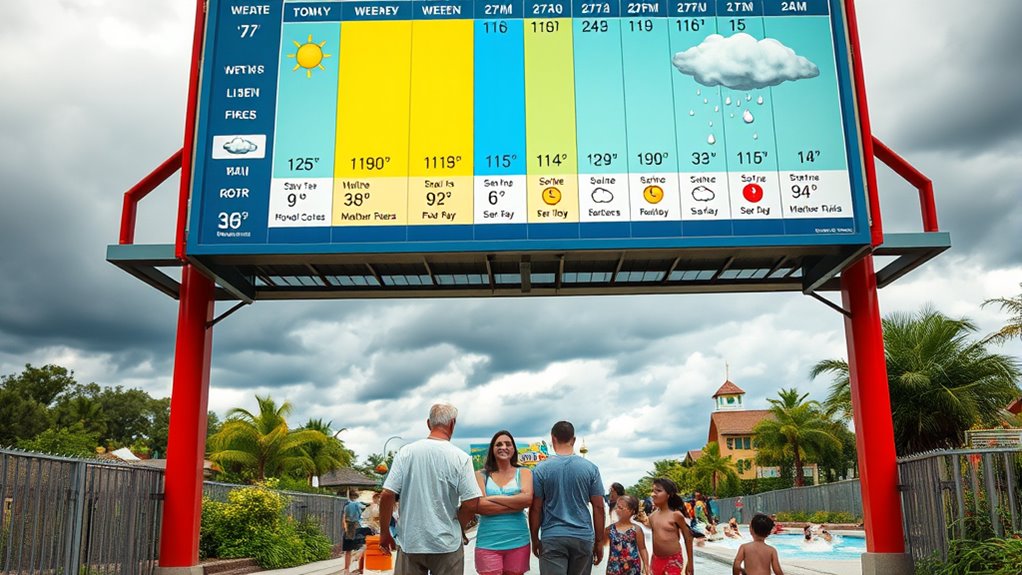
Understanding probabilities and uncertainty in weather forecasts is essential for making informed decisions. When a forecast says there’s a 30% chance of rain, it means there’s a 30% likelihood that measurable rain will occur somewhere within the region during that period, not that 30% of the area will be wet or it will rain for 30% of the time. Probabilities are based on forecasters’ confidence and the expected coverage of precipitation. Visual tools like color maps and probability contours show where rain might happen, but they can be misleading if you don’t consider the underlying uncertainty. Remember, higher probabilities over large areas don’t guarantee rain everywhere inside them. Recognizing this helps you better interpret forecast information and prepare for a range of possible weather outcomes. Additionally, understanding the concept of forecast accuracy can help you evaluate how much trust to place in predictions.
Using Short-Term Forecasts to Plan Daily Operations

You can use short-term forecasts to stay ahead of changing weather conditions and keep operations smooth. Monitoring key weather shifts helps you adjust ride schedules and outdoor activities quickly. Understanding store hours and planning accordingly can also prevent disruptions during peak times. Prioritizing guest safety guarantees everyone has a fun, secure experience, no matter what the forecast predicts. Leveraging high-resolution weather data allows you to anticipate severe weather events more accurately and implement timely safety measures.
Monitoring Key Weather Changes
Monitoring key weather changes using short-term forecasts is vital for making timely operational decisions at water parks. These forecasts, updated every 15-30 minutes, help you respond quickly to sudden weather shifts like thunderstorms, high winds, or temperature drops. Real-time data from on-site weather stations enhances accuracy for your specific location. Keep a close eye on temperature fluctuations, as they affect guest comfort and safety, especially during heat waves or cold snaps. Precipitation intensity and duration determine pool closures and safety measures. Wind speed and direction influence ride operations and lightning risk, while lightning alerts are essential for guest evacuation. Automated alerts and centralized dashboards help staff respond promptly to weather changes, ensuring you stay informed, enabling proactive responses that protect guests and staff, and minimize disruptions. Incorporating weather forecasting into your safety protocols is an essential part of comprehensive water park management.
Adjusting Ride Schedules
Short-term weather forecasts are essential tools for planning daily ride operations at water parks. They help you decide when to delay opening, close rides early, or stagger schedules to avoid unsafe conditions. Using hourly updates from NOAA and Weather.gov, you can anticipate wind, rain, or temperature shifts. For example, if high wind warnings are issued, you might close rides like Lightning Rod and Wild Eagle proactively. Here’s how forecast data influences decisions:
| Condition | Action | Time Frame |
|---|---|---|
| Wind gusts > 50 mph | Close high-wind rides | Up to 48 hours ahead |
| Temperature < 40°F | Delay opening or close rides | Daily, as needed |
| Heavy rain/hail | Halt operations temporarily | Hour-by-hour updates |
Staying alert allows you to adapt ride schedules for safety and guest experience. Monitoring weather patterns regularly helps ensure timely responses to changing conditions, further safeguarding both guests and staff. Additionally, understanding water park weather forecasts can guide maintenance and staffing plans to optimize operations during variable conditions.
Ensuring Guest Safety
Effective management of guest safety during changing weather conditions relies on real-time information and prompt decision-making. You should continuously monitor weather using radar, lightning detection, and updates from weather apps or the National Weather Service. Set clear thresholds, like lightning within 5-10 miles, to trigger ride closures and evacuations. Track wind speeds and gusts to determine water ride safety, closing those at risk during high winds. Maintain communication with meteorological agencies for timely severe weather alerts. When lightning strikes within the safety radius, close all water attractions immediately and evacuate guests to safe indoor areas. Postpone reopening until 30 minutes after the last lightning strike outside the danger zone. Use digital signage and announcements to keep guests informed and ensure safety protocols are followed meticulously. Regularly reviewing indoor air quality can help identify potential health risks in enclosed spaces where guests and staff spend significant time.
Planning Ahead With Medium-Range Weather Outlooks

Planning ahead with medium-range weather outlooks allows you to make informed decisions about your water park visit by evaluating forecasts 3 to 7 days in advance. These forecasts are generally more reliable than long-range outlooks, especially for key parameters like temperature, precipitation, and wind. Using resources from the National Weather Service or weather apps, you can track changes in weather patterns and adjust your plans accordingly. Monitoring forecast confidence—especially when multiple models agree—helps you prepare for high-pressure days or potential storms. Pay attention to temperature highs and lows, chances of rain, UV index, and wind conditions. Checking the forecast regularly within this window ensures you stay updated on any shifts, helping you optimize your visit for safety, comfort, and fun. Being aware of cultural weather patterns can also provide additional context for regional variations in weather behavior.
Making Strategic Decisions Based on Long-Range Trends

Understanding long-range weather trends is essential for making informed decisions about your water park operations and guest experience. These trends, derived from sophisticated models and historical data, reveal probable seasonal patterns rather than exact weather events. By analyzing probabilities of above, normal, or below-average conditions, you can plan staffing, merchandising, and maintenance proactively. Long-range forecasts, with accuracy up to 85%, enable you to optimize revenue through weather-informed promotions and resource allocation months in advance. Recognizing that atmospheric conditions only retain reliable information for about two weeks highlights the importance of focusing on broader trends rather than specific daily forecasts. Using these insights, you can better anticipate visitor attendance fluctuations and weather impacts, ultimately enhancing guest satisfaction and operational efficiency. Advances in modeling techniques and data assimilation are continually improving the reliability of long-range forecasts, giving you more confidence in planning ahead. Additionally, understanding weather pattern shifts and their influence on seasonal conditions can further refine your strategic planning.
Applying Forecast Insights to Ensure Guest Safety and Comfort
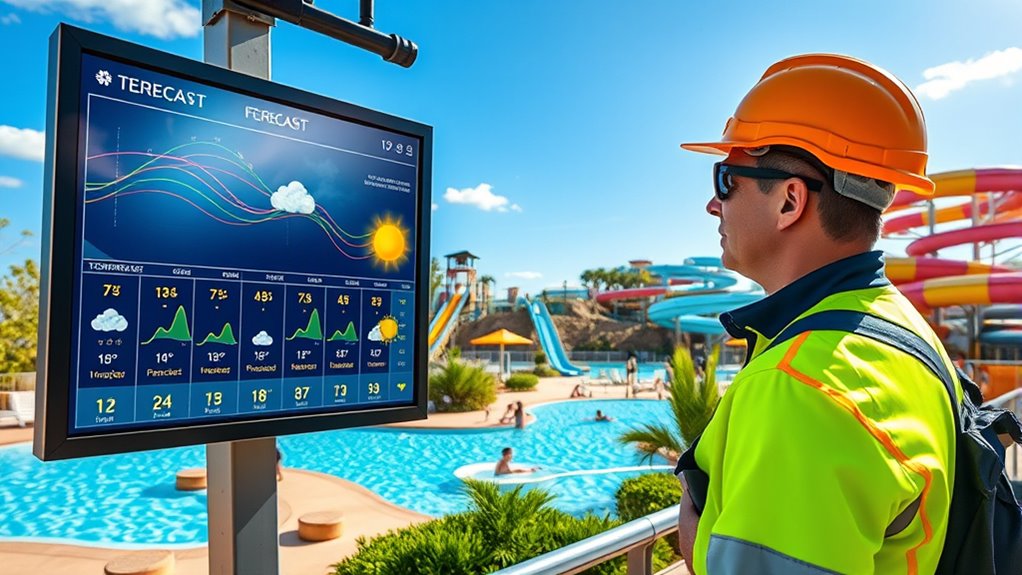
Staying ahead of weather changes is essential for maintaining guest safety and comfort at your water park. By applying forecast insights, you can proactively manage risks and enhance guest experience. Use real-time weather alerts broadcast through park-wide systems, mobile apps, and signage to keep everyone informed. Guarantee shelters are accessible and clearly marked, so guests can quickly find safety during severe weather. Conduct regular drills to familiarize staff and visitors with evacuation procedures. Implement lightning safety protocols, closing attractions and guiding guests to shelters when needed. During heatwaves, promote hydration with stations and shaded zones, and expand indoor areas for relief. Continuously monitor weather forecasts to adjust operations and communicate updates promptly. Understanding weather patterns in your location can help you better prepare for seasonal changes and unexpected storms. – Use alerts for timely guest notifications – Keep shelters well-marked and accessible – Train staff on emergency procedures – Promote hydration and shade during heat – Expand indoor activities during storms
Frequently Asked Questions
How Accurate Are Ai-Enhanced Weather Forecasts for Water Park Operations?
AI-enhanced weather forecasts are quite accurate for water park operations, often up to 20% better than traditional models. They provide localized, actionable predictions for short-term events like storms or heatwaves, helping you plan safety measures and manage attendance. While AI models excel in predicting common weather patterns, be aware they may struggle with rare or extreme events, so always consider uncertainties and have contingency plans in place.
What Is the Best Way to Interpret Forecast Probabilities for Safety Decisions?
You might think a low chance means no worries, but ignoring forecast probabilities can be risky. For safety, always interpret probabilities above key thresholds—like over 50% for rain or 30% for thunderstorms—as cues to prepare or close rides. Use clear communication and act promptly when risks cross these thresholds. Remember, even seemingly small chances can escalate; being proactive keeps everyone safe, rain or shine.
How Do Different Precipitation Measurement Tools Impact Forecast Reliability?
You should understand that different precipitation measurement tools influence forecast reliability by varying in accuracy and consistency. For example, weighing gauges and piezoelectric sensors provide precise data, reducing errors, while tipping bucket gauges might drift over time, causing inaccuracies. Combining tools, maintaining calibration, and considering environmental factors help improve forecast precision. Relying on well-maintained, accurate instruments guarantees your weather predictions are more trustworthy, aiding safer planning and decision-making.
Can Ensemble Forecasts Predict Extreme Weather Events With High Confidence?
Ensemble forecasts can predict extreme weather events with high confidence, but they aren’t foolproof. You need to look at the spread among ensemble members; low spread means higher confidence, while high spread indicates uncertainty. Advances in AI and machine learning have improved prediction accuracy, especially for extreme events. However, always remember that some fine-scale details may still be missed, so stay updated with official alerts for the most reliable info.
How Frequently Should Water Parks Update Their Operational Plans Based on Forecast Changes?
You should update your water park plans at least every four hours, but don’t get complacent—volatile weather can strike with lightning speed. During storms or high winds, refresh your plans hourly or more. Keep an eye on real-time data, radar, and alerts to stay ahead of surprises. Flexibility is your best friend; the more you adapt swiftly, the safer and happier your guests will be.
Conclusion
By understanding weather forecasts, you can better plan your water park day and keep guests safe. Did you know that accurate weather predictions have improved by over 50% in the past decade thanks to AI? So, next time you check the forecast, remember it’s not just about rain or shine—it’s about creating a fun, safe experience for everyone. Stay informed, stay prepared, and enjoy your water park adventure!