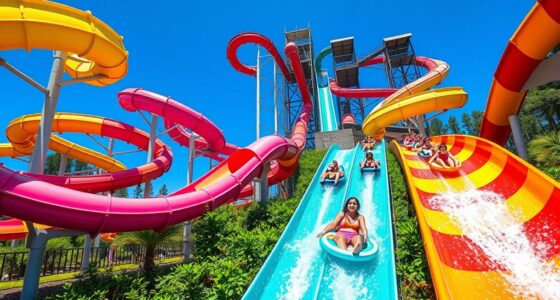
Lazy rivers use pumps to circulate water smoothly, creating gentle currents you can relax in. Strategic pump placement, combined with jets along the channel, guides flow and prevents stagnation. Safety features like designated entry points, slip-resistant surfaces, and life jackets keep you secure while the water’s design minimizes turbulence and structural stress. Understanding these systems helps guarantee a safe and relaxing experience, and there’s more to explore about how engineers optimize flow and safety in lazy rivers.
Key Takeaways
- Pumps circulate water through the lazy river, creating continuous flow and preventing stagnation.
- Strategically placed jets and channel design regulate water speed and direction for a smooth, relaxing ride.
- Variable flow systems and CFD analysis optimize flow, reduce turbulence, and enhance safety along curves and bends.
- Safety features include designated entry/exit points, safety gear, and structural reinforcement against hydrodynamic forces.
- Water quality is maintained through filtration, circulation, and regular cleaning, ensuring a safe and enjoyable experience.
Top picks for "lazy river work"
Open Amazon search results for this keyword.
As an affiliate, we earn on qualifying purchases.
Pump Systems and Power Sources

Pump systems are the heart of lazy rivers, providing the flow that keeps the water moving smoothly. Most commonly, you’ll find horizontal end-suction centrifugal pumps, with horsepower ranging from 10 to 40, depending on the river’s size and flow requirements. Some advanced systems, like “TIGRIS” and “VOLGA,” use high-flow turbines with motors and electrical parts separated from water for safety and durability. “TIGRIS” offers three configurations, from 7.5 to 15 kW motors, delivering flows between 3,500 and 4,500 m³/h. “VOLGA” uses a vertical pump with a 15 kW motor, handling 3,000–3,500 m³/h. Riverflow systems incorporate Variable Frequency Drives (VFD), which optimize energy use by adjusting flow speeds and converting residential power into industrial-grade power, reducing energy consumption considerably. Proper pump placement is crucial to ensure even water circulation and prevent issues like cavitation or uneven flow.
Mechanics of Water Movement
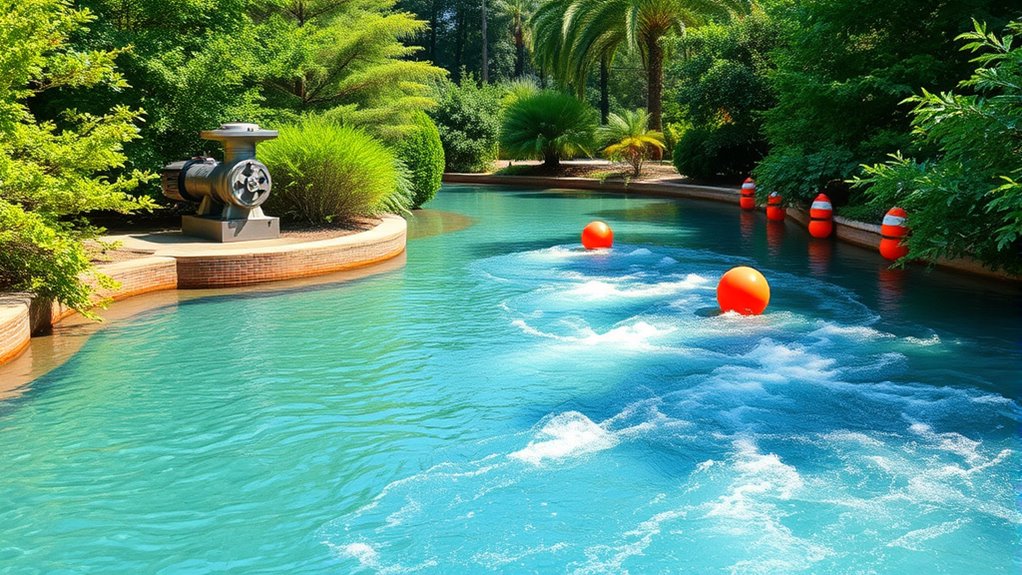
Water movement in lazy rivers relies on a carefully balanced system of circulation dynamics, where continuous flow maintains a gentle, steady pace that mimics natural currents. You’ll find that the flow rate typically stays between 1 and 2 miles per hour, ensuring a relaxing drift without feeling rushed. Pumps push water into jets strategically placed along the channel, creating momentum that guides the current. The shape and size of the river channel—its depth, width, and curves—direct water velocity and flow patterns. To keep everything smooth, designers use wall and floor jets to prevent stagnation and control speed. Proper management of flow around curves prevents water pooling or spilling, maintaining safety and comfort for everyone on the ride. The shape of the channel influences flow speed and direction. – Pumps and jets work together to sustain continuous movement. – Channel design influences water velocity and flow patterns. – Jets help prevent stagnation and control flow speed. Additionally, understanding circulation dynamics helps engineers optimize flow and safety.
Jet Placement and Flow Regulation

Effective jet placement and flow regulation are crucial for maintaining a smooth, consistent current in lazy rivers. You should position jets protruding from walls rather than floors to prevent tripping hazards and enhance safety. Align nozzles to direct water flow in the intended direction, avoiding dead zones or reverse currents. Slight upward or downward tilts optimize jet angles; too far downward wastes energy, while aiming too high creates bubbles without enough force. Strategic placement near features like islands or bends helps control flow and improve rider experience. Using either a single powerful nozzle or multiple jets ensures steady, uniform flow, especially around curves and entry points. Paired with variable-speed pumps, adjustable jets let you fine-tune the current, preventing stagnant areas and improving energy efficiency. Incorporating Kia Tuning techniques, such as optimized pump settings and jet positioning, can further enhance the flow control and energy efficiency of the lazy river system.
Filtration and Water Quality Maintenance

Ever wondered how lazy rivers stay clean and clear? It all comes down to effective filtration and water quality maintenance. Your system uses separate filters—like sand, cartridge, or DE filters—that operate independently from flow pumps to save energy. Carefully placed inlets and skimmers catch debris before it bypasses filtration, keeping water pristine. Collector tanks serve as reservoirs and filtration zones, housing filters for continuous cleaning. Regular maintenance is key: skimmers, vacuums, and manual cleaning prevent organic buildup, while backwashing or bump cycles restore filter efficiency. Monitoring pressure differences guarantees timely cleaning. For added safety, some facilities use UV or ozone treatments to reduce pathogens. Proper filtration keeps your lazy river inviting, safe, and sparkling clear. Trust issues with water systems can arise if filtration components are neglected, emphasizing the importance of routine checks.
Safety Measures and User Comfort

Maintaining safety and ensuring user comfort are top priorities in lazy river design and operation. You’ll find rules that prohibit climbing, running, pushing, or horseplay to minimize injury risks. Entering and exiting only at designated areas helps prevent accidents and congestion. Chain or train tube riding is limited to three linked tubes to avoid tipping. Glass containers, eating, and drinking are banned to keep the water clean and prevent choking hazards. Life jackets are recommended or required for children and non-swimmers, with staff providing free options to encourage their use. Well-trained lifeguards monitor the area, ready to respond quickly, while safety signage and slip-resistant surfaces guide safe behavior. Clear pathways and visible emergency stations further enhance safety and user comfort throughout the lazy river experience. Staff training and emergency preparedness ensure that staff can respond effectively to incidents, further safeguarding all visitors. Additionally, security protocols aligned with industry standards help maintain a secure environment for everyone.
Design Principles and Structural Considerations

Designing a lazy river requires careful attention to channel geometry and structural elements to guarantee safety, durability, and user enjoyment. You must choose a width of around 3 meters or more to prevent congestion and ensure comfortable circulation. Water depth should be close to 0.75 meters, providing enough buoyancy without risking safety. Gentle curves and winding layouts mimic natural rivers, extending fun. Strategic placement of entrance and exit points allows smooth user flow without disrupting current. You’ll need durable materials like fiberglass, concrete, or shotcrete for the channel base and walls to withstand water and force. Reinforcement is essential for hydrostatic pressure. Surface finishes should be slip-resistant and easy to clean. Incorporating structural integrity into the design ensures the lazy river can support continuous operation and withstand environmental stresses. Integrating enclosures seamlessly into the landscape helps protect equipment while maintaining aesthetics. Proper structural design ensures the lazy river can support continuous operation and withstand environmental stresses.
Operational Efficiency and Engineering Dynamics

You need to understand how pump selection and placement influence the lazy river’s flow and energy use. Proper flow optimization techniques are vital for maintaining guest comfort while minimizing costs. Additionally, calculating structural forces guarantees your system remains safe and durable under operational stresses. The pumps are typically driven by inverters, which extend motor lifespan and allow for precise control of flow rates. Incorporating energy-efficient technologies can further reduce operational expenses and environmental impact.
Pump Selection and Placement
Selecting the right pump type and strategically placing it are crucial steps in guaranteeing a lazy river operates efficiently and reliably. Your choice depends on factors like flow rate, river size, and desired current speed. Horizontal end-suction centrifugal pumps are common for their reliability, while axial flow pumps move large volumes with less horsepower, ideal for bigger rivers. Propulsion systems are increasingly used for better control. Proper placement ensures even water distribution and minimizes dead zones; pumps are usually positioned at the start or along the river’s path. Consider accessibility for maintenance as well. Commercial quality pumps are necessary to handle the continuous large volumes of water in residential lazy rivers. Use axial flow pumps near the river for peak performance. Place pumps at strategic points to maintain consistent flow. Guarantee easy access for repairs and routine checks. Additionally, understanding the engineering dynamics involved can help optimize pump efficiency and lifespan.
Flow Optimization Techniques
Optimizing flow within a lazy river requires careful attention to operational efficiency and the underlying engineering dynamics. You use Computational Fluid Dynamics (CFD) simulations to fine-tune volume, velocity, and direction, enabling you to visualize turbulence, vortices, and hydraulic jumps with industry-standard tools like Ansys Fluent. Rapid model iteration helps you make design adjustments before construction, ensuring smooth water behavior through bends and turns. Proper inlet and outlet placement, angled to reduce turbulence, maintain consistent flow and prevent stagnation. Wide turns and jets in corners help sustain momentum and avoid floating patrons drifting. Variable speed systems, controlled via frequency variators, allow you to adjust flow rates in real-time for ideal speed, efficiency, and rider experience. Regular filtration and water quality checks keep the system clean, safe, and running smoothly. Advanced CFD analysis enables precise flow modeling, which further enhances the safety and comfort of lazy river patrons. Additionally, implementing flow control mechanisms helps in maintaining optimal circulation and preventing dead zones within the system.
Structural Force Calculations
Understanding the structural forces acting on a lazy river is essential for guaranteeing safety and operational efficiency. You must account for rider loads, including point loads of 1.33 kN and distributed loads over specified areas. Lateral centripetal forces in curves, based on velocities around 4.6 m/s, also impact wall design. Hydrodynamic pressures from water flow and rider occupancy influence structural stress, especially in bends where water surface tilts exceed 8 cm. Additionally, static and dynamic forces on the channel walls and floor require careful calculations to prevent failure. You should consider:
- Load distribution to handle peak rider and water forces
- Reinforcement in curved sections to counteract lateral and hydrodynamic stresses
- Material selection for durability against erosion, vibrations, and fatigue
- Structural analysis ensures a safe, efficient lazy river design.
Frequently Asked Questions
How Do Lazy Rivers Prevent Water From Spilling During Sharp Turns?
You can prevent water from spilling during sharp turns by designing the channel with curved walls and raised banks that act as barriers. The outside of turns is often wider and sloped to contain water, while sloped or rounded edges guide water smoothly around bends. Additionally, splash guards and retaining walls help contain water, and flow is carefully managed with pumps to keep the velocity low, reducing splashing and overflow.
What Materials Are Used for Constructing the River’s Channel and Walls?
You’ll find that concrete forms the backbone of your lazy river, shaping sturdy, long-lasting channels and walls. It’s combined with gunite or shotcrete for seamless, watertight construction, and reinforced with steel rebar to withstand pressure and movement. Sometimes, fiberglass panels or PVC liners are added for quick assembly or extra waterproofing. Finishes like tiles or natural stones top it off, creating a visually stunning, slip-resistant surface for everyone to enjoy.
How Often Should the Filtration System Be Maintained for Optimal Performance?
You should inspect and maintain the filtration system every 4-6 weeks during peak use to keep it running smoothly. In high-traffic or debris-heavy environments, cleaning intervals may shorten to every 2-4 weeks. Regularly check pressure gauges weekly, and if they rise 8-10 psi above baseline, clean or service the filters. Seasonal overhauls and annual professional inspections guarantee maximum performance and safety.
Can Variable-Speed Pumps Automatically Adjust Flow Based on User Load?
Yes, your lazy river’s variable-speed pump can automatically adjust flow based on user load—imagine that, a pump that senses your needs and adapts without you lifting a finger. Thanks to smart feedback systems, it modulates speed to keep currents just right, saving energy and enhancing safety. So, while you relax or play, the pump’s quietly working behind the scenes, making sure everything runs smoothly and efficiently.
What Safety Features Are in Place for Emergency Swimmer Exit Points?
You’ll find safety features at emergency swimmer exit points include handrails and non-slip surfaces to prevent falls, clear signage with rules and instructions, and lighting to enhance visibility. Depth markers inform you of water conditions, while safety barriers prevent access to mechanical areas. Additionally, life vests are recommended, and emergency equipment like first aid stations are nearby. Routine inspections guarantee all exit pathways are safe, accessible, and ready for quick, secure evacuations when needed.
Conclusion
Now that you understand how lazy rivers work, imagine the mysteries behind their seamless flow and safety features. Every pump, jet, and filter plays a vital role, but what if one element falters? The intricate balance keeps you floating effortlessly—yet beneath the surface, engineers constantly tweak and fine-tune. The secrets of lazy rivers remain hidden just beneath your gaze, waiting to be uncovered. Are you ready to explore what truly makes them flow so smoothly?