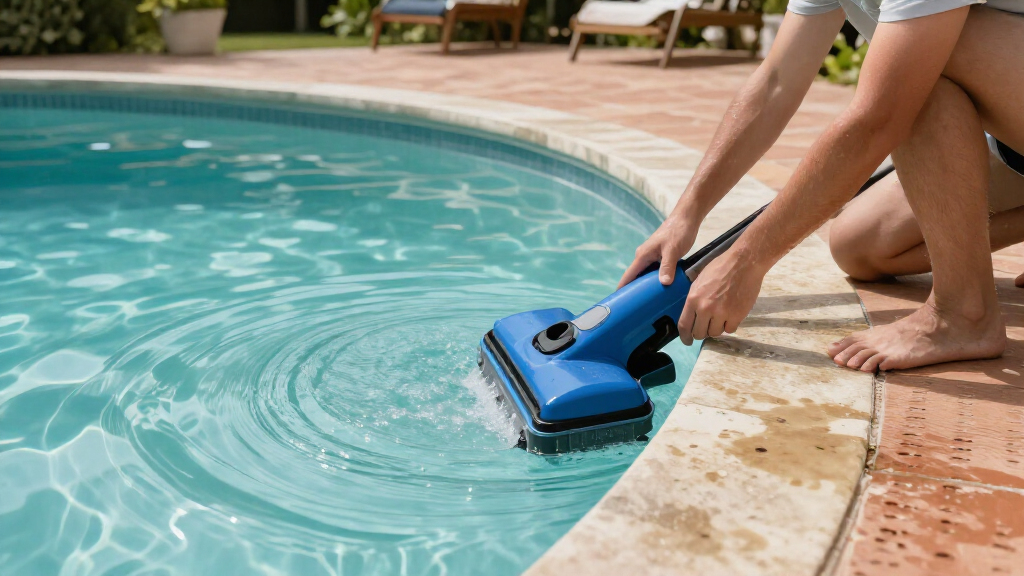
TL;DR
Automatic pool cleaners collect dirt and debris with less hands-on work, but they do not replace your pool’s pump, filter, water testing, or brushing. Suction-side, pressure-side, and robotic models work in different ways, so choose by pool compatibility, debris, coverage, upkeep, and operating costs rather than by features alone.
A pool cleaner can spend an hour circling the deep end and still leave a dusty step untouched. That’s the catch with automatic pool cleaners: they can save you regular hand-cleaning, but the right fit depends on your pool, your debris, and what you expect them to do.

Get pool and patio gear delivered free with Prime
- Fast, free delivery on millions of items
- Prime Video, Amazon Music and more included
- Member-only deals all year
This guide explains how suction-side, pressure-side, and robotic cleaners differ, which details matter before you buy, and what routine maintenance they still need. You’ll also see why a cleaner can remove dirt and debris with little effort while leaving water testing and circulation to you.
For instance, a pool beneath leafy trees has a different daily problem from a small pool that collects fine dust. Think of the cleaner as a helpful kitchen assistant: it can handle one job well, but it won’t plan the whole meal. Use these key facts for choosing a model to match the machine to the work your pool actually needs.
Choose among suction-side, pressure-side, and robotic cleaners by checking your pool’s plumbing, debris, layout, and surface.
Large leaves and fine dust call for different debris handling and filter choices; check capacity and cleaning needs.
Confirm wall, floor, and waterline coverage, plus hose or cord reach, against the manufacturer’s model guidance.
Budget for cleaning and replacement parts as well as purchase price, pump time, or booster-pump needs.
Keep skimming, brushing, circulation, filter checks, and water testing in your regular pool-care routine.
Know What Each Automatic Pool Cleaner Actually Does
Automatic pool cleaners collect dirt and debris using the pool’s suction, return-line pressure, or a separate motor and filter. They help keep the pool cleaner between manual cleanings, but they do not replace your pump, filter, water testing, or chemical balancing. The distinction matters because picking up debris from surfaces is a different job from circulating and filtering water throughout the pool.
A suction-side cleaner connects to a skimmer or dedicated suction line and uses the pool pump to draw in debris. That can make it a relatively simple setup when the plumbing is compatible, but the cleaner draws on the same pump that circulates water. Its operating schedule can therefore affect pump workload and compete with other suction tasks. A pressure-side cleaner uses water returning to the pool, sometimes with a booster pump; many models collect debris in their own bag, so less debris reaches the main filter. The tradeoff is that a booster pump adds equipment and operating needs, while the bag still needs regular emptying.
A robotic cleaner has its own motor and debris filter and runs independently of the main circulation system. For instance, if your existing pump runs on a schedule, a robot may clean the pool without being tied to that schedule. That independence can give you more flexibility, but it does not make the pool’s pump and filter optional: they move and filter water beyond the area the robot touches. The cleaner picks up debris; your circulation system moves and filters water throughout the pool.
It helps to think of these machines as different tools in a garage. A leaf rake, shop vacuum, and pressure washer all tidy things up, but each handles a different job. Before buying, check how a model connects, what it collects, and what the manufacturer says about your pool. Those details show whether it fits your existing setup and whether its strengths address the debris you actually have.
Products Worth Considering

GoPro Fluid Pro AI 3-Axis Gimbal Stabilizer with AI Tracking and Fill Light

Apple AirPods Pro 3 Wireless Earbuds with Active Noise Cancellation

GoPro HERO12 Black Waterproof Action Camera with 5.3K60 Video and 27MP Photos
As an affiliate, we earn on qualifying purchases.
Match the Cleaner to Your Pool’s Debris and Shape
The best cleaner for your pool depends on its plumbing, size, shape, surface, and surroundings. A large, open pool with mostly sand has different needs from a pool under overhanging trees, where wet leaves can gather in corners and clog a small intake. These factors affect more than convenience: a cleaner that cannot reach the debris or hold it efficiently may need frequent attention and still leave you with manual work.
Start with the debris. If you often scoop big leaves from the water, check whether the cleaner can handle them and whether it has a bag or filter with enough capacity. A larger capacity may let it run longer before you intervene, but it also means you still need to empty and rinse the collection area. If fine dust settles on the floor, check the filter options: a model that catches leaves may not capture very fine particles as effectively. Capacity matters, but so does the size of the debris the filter is designed to trap; a full or unsuitable filter can restrict pickup and leave dust behind.
Then look at the layout. A square pool with broad, easy-to-reach floors asks less of a cleaner than one with benches, tight corners, steep slopes, and many steps. Some models climb walls or scrub the waterline, but steps and unusual features can still be difficult. Picture a cleaner tracing the floor of a kidney-shaped pool: curves and narrow coves may interrupt its route, so advertised coverage of floors or walls does not guarantee that every nook gets cleaned. If you expect the machine to handle those spots, check what the maker says about the exact model and be prepared to brush or clean them yourself.
Use the manufacturer’s compatibility guidance for your pool surface and layout, especially if you have an above-ground pool, a particular finish, or saltwater. Compatibility can vary between models, so don’t assume that a feature name means the cleaner will suit your pool. A model that is wrong for the surface or plumbing can be a poor fit even if its cleaning features look appealing.
Compare the Three Types Before You Spend
Cleaner type changes how the machine connects, collects debris, and affects your routine. Suction-side models rely on the pool pump, pressure-side cleaners use return-line pressure and may need a booster pump, and robotic cleaners generally have their own motor and filter. These differences shape the ongoing work as much as the initial setup: one may add pump time, another may require a separate pump, and a robot may shift routine attention to its own filter and power source. Compare specific models against your pool instead of treating one type as best for every owner.
| Type | How it works | What to check |
|---|---|---|
| Suction-side | Connects to the skimmer or a suction line | Pump workload, hose reach, flow needs |
| Pressure-side | Uses return-line pressure; some need a booster pump | Booster pump, bag capacity, hose reach |
| Robotic | Uses its own motor and debris filter | Filter cleaning, cord or battery, coverage |
For example, a pool owner with a strong existing pump and a modest budget might favor a simple suction-side model, though the added pump workload and required flow still need to suit the system. Another owner with heavy leaf fall may value an onboard bag that keeps some debris out of the main filter; the benefit is less debris sent through that filter, balanced against emptying the bag. A robot may suit someone who wants cleaning independent of the main circulation schedule, provided the pool setup and operating costs make sense. That freedom can simplify scheduling, but it does not do the pool’s circulation work.
Cost includes the whole routine, not just the purchase price. Consider how often the cleaner will run, whether it needs a booster pump or extended pump operation, and how easy it is to find replacement brushes, filters, bags, hoses, or tracks. A less expensive cleaner can cost more to operate if it adds pump time or needs parts that are difficult to source. A warranty is more useful when the parts it covers and local support are clear, since wear items and service can affect the value over time.
Use Smart Features as Helpful Extras, Not Promises
Programmable schedules, sensors, mapping, and app controls can make some cleaners easier to manage, but they do not guarantee perfect coverage. Navigation features can help a model plan or repeat a route, yet the pool’s shape, obstacles, and the cleaner’s design still determine where it can go. Some models aim to improve navigation or reduce missed areas; a cleaner may still skip a corner, struggle with steps, or need you to reposition it.
Cordless robotic models trade a power cord for a rechargeable battery. That can mean fewer cord tangles around the pool, but you’ll need to understand battery runtime, charging, and whether one cycle covers your pool. For instance, if your pool is large or has a complicated shape, check the maker’s stated coverage and cycle details rather than assuming “cordless” means hands-off. A shorter run time may mean more charging or more than one cycle, which can reduce the convenience that drew you to a cordless model.
Most models connect to something: a skimmer, a return line, or a power source. The phrase most models connect to a defined part of your setup is a useful reminder to check compatibility before ordering. Cord length, hose reach, swivel features, and storage instructions can all affect whether the unit reaches the far wall without tangling. If reach or storage is inconvenient, a feature-rich model may still be awkward to use regularly.
Smart alerts can tell you when a cycle ends or a filter needs attention, but the cleaner still depends on you to empty its basket or rinse its filter. Think of an app as a dashboard, not a chauffeur: it can report what the machine is doing, but it cannot see every leaf stuck behind a ladder. Product features and availability change, so verify current specifications with the manufacturer.
Build a Short Routine Around the Cleaner
A simple routine helps you catch clogs, missed areas, and wear before they turn into a frustrating pool day. The cleaner does the repeated floor work; you check whether it is actually keeping up and take care of jobs it cannot do. A quick check after a cycle can reveal a full filter or tangled hose before those issues keep recurring.
- Check the pool and cleaner’s instructions. Confirm compatibility and follow the manual for setup, water conditions, and cycle use. This avoids running a unit in conditions or on a surface its maker does not support.
- Clear baskets and visible blockages. Remove leaves from the skimmer and inspect the intake if the cleaner slows down. A blockage can reduce the flow or pickup the cleaner relies on.
- Run a cycle that fits the debris load. A windy evening under trees may call for more attention than a calm day with little debris. Matching cycles to conditions helps avoid both missed debris and unnecessary operation.
- Empty or rinse the bag or filter. A full filter can restrict pickup, much like a vacuum loses suction when its bin is packed. Cleaning it after use keeps the next cycle from starting with reduced capacity.
- Inspect brushes, moving parts, hose, or cord. Look for hair, twists, wear, or anything that keeps the cleaner from reaching the pool. Small snags can explain repeated missed areas before they become a larger repair.
- Brush, skim, and test the water separately. Follow your usual care schedule for circulation and chemistry. The cleaner’s surface pickup does not tell you whether the water is balanced or fully circulated.
Imagine the robot misses the same shallow corner after every run. First clear its filter and check the route for a hose or cord twist, then consult the model’s layout guidance. If the cleaner still stalls, inspect for a blocked intake or worn part before deciding the machine has failed. Repeatedly missed spots can point to a route or access limitation, so they may need manual brushing even when the unit is working normally.
Follow the manufacturer’s storage guidance, including whether the cleaner should come out after a cycle. Some units are designed to be removed; leaving a cleaner in the water longer than recommended can affect components or make routine pool use less convenient.
Remember What a Cleaner Can’t Take Off Your Hands
An automatic cleaner is a maintenance aid, not a complete pool-care system. It may pick up debris while leaving fine dust behind, miss corners, or struggle with unusual features. Overloading can clog it, and even wall-climbing models may not scrub every step or waterline as well as you expect. That means a clean-looking floor is useful evidence of pickup, but not proof that every surface or the water itself is in good condition.
A pool can look clear and still need proper water care. The cleaner does not test the water or balance its chemicals, and a robotic unit that filters its own debris does not make the main circulation system unnecessary. Keep up with skimming, brushing, emptying baskets, checking the pool filter, and testing the water as your normal care routine requires. These tasks cover the water and locations the cleaner cannot assess or reach.
For example, after a windy night, a cleaner may remove leaves from the floor while a layer of floating debris stays near the surface. You may still need to skim the pool and empty the skimmer basket. If the water looks cloudy, don’t assume another cleaning cycle will fix the cause; check water balance and filtration according to your pool-care guidance. Surface debris, floor debris, and cloudy water can have different causes, so matching the response to the problem saves time.
The cleaner handles pickup; you remain responsible for circulation, water testing, and the spots it misses.
That division of work makes a cleaner more useful, not less. Set expectations around the jobs the model is designed to do, and keep an eye on the pool itself. If children use the pool, keep an adult actively supervising them and follow drowning-prevention measures; the cleaner never makes a pool safe to leave unattended.
Frequently Asked Questions
Which type of automatic pool cleaner is best for my pool?
It depends on your pool’s plumbing, size, shape, surface, debris, and budget. Compare compatible models against those needs: a suction-side cleaner uses the pool pump, a pressure-side model uses return-line pressure, and a robotic cleaner generally has its own motor and filter.
Can an automatic cleaner replace my pool pump or filter?
No. Cleaners supplement pool care; they do not replace the circulation and filtration system. A robotic cleaner can run independently of the main system while the pool still needs proper circulation and filtration.
Can a cleaner pick up both leaves and fine dust?
Capabilities vary by model and filter. A cleaner suited to leaves may not capture very fine particles as effectively. Check the manufacturer’s debris limits and filter options, especially if your pool gets both large leaves and dust.
Will my cleaner scrub walls, steps, and the waterline?
Some models climb walls or scrub the waterline, while others focus mainly on the floor. Steps, tight corners, and unusual shapes can still challenge a cleaner. Check the coverage description for your exact model before buying.
How often should I run an automatic pool cleaner?
Set the schedule according to how quickly debris gathers and the model’s guidance. A pool under trees may need more frequent cycles than one with little nearby debris. Check whether the pool is clean and whether the cleaner is keeping up, rather than relying on a schedule alone.
How much maintenance does a pool cleaner need?
Plan to empty or rinse its filter or bag and clear hair or debris from brushes and moving parts. Check hoses or cords for twists and wear, and follow the manual’s cleaning and storage instructions. A clogged intake or filter can slow a cleaner or make it miss areas.
Conclusion
Choose the cleaner that fits the work your pool actually creates: leaves, dust, plumbing, shape, and the time you want to spend on upkeep. Check compatibility and coverage with the manufacturer, then keep the cleaner’s filter clear and your pool’s circulation and water care on schedule.
A cleaner can quietly patrol the pool floor, but you’re still the one keeping the whole pool healthy. Let the machine chase the debris; keep an eye on the water.