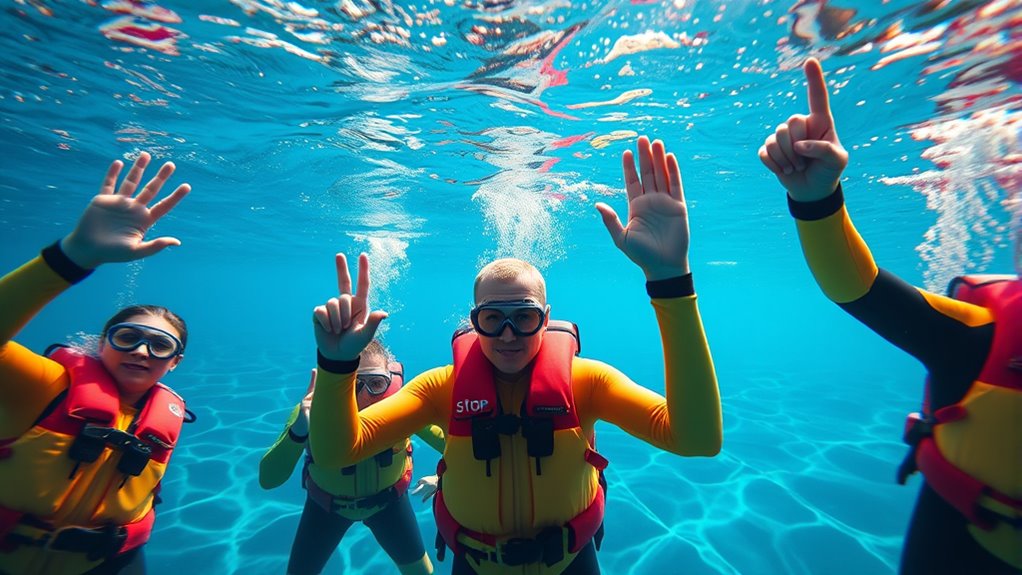

In water safety, you’ll use universal hand signals to communicate quickly and clearly. For example, crossing both arms signals a missing swimmer, while raising one arm up indicates help is needed. Waving a hand or forming a circle can alert others to distress. These signs are vital for smooth rescue efforts. Mastering these signals ensures effective teamwork and safety. Keep exploring, and you’ll discover more essential gestures to enhance your water safety skills.

Get pool and patio gear delivered free with Prime
- Fast, free delivery on millions of items
- Prime Video, Amazon Music and more included
- Member-only deals all year
Key Takeaways
- Universal signals include crossing both arms overhead for a missing swimmer and raising one arm vertically for assistance.
- Waving one arm in a circle while the other remains parallel indicates distress and need for rescue.
- The ‘OK’ sign with thumb and forefinger confirms safety or that all is well underwater.
- Raising both arms above the head in a cross signals a swimmer is missing and presumed submerged.
- Clear, deliberate gestures are essential for effective communication in water rescue situations across international teams.
water rescue hand signal training kit
As an affiliate, we earn on qualifying purchases.
As an affiliate, we earn on qualifying purchases.
Essential Lifeguard Hand Signals and Their Meanings
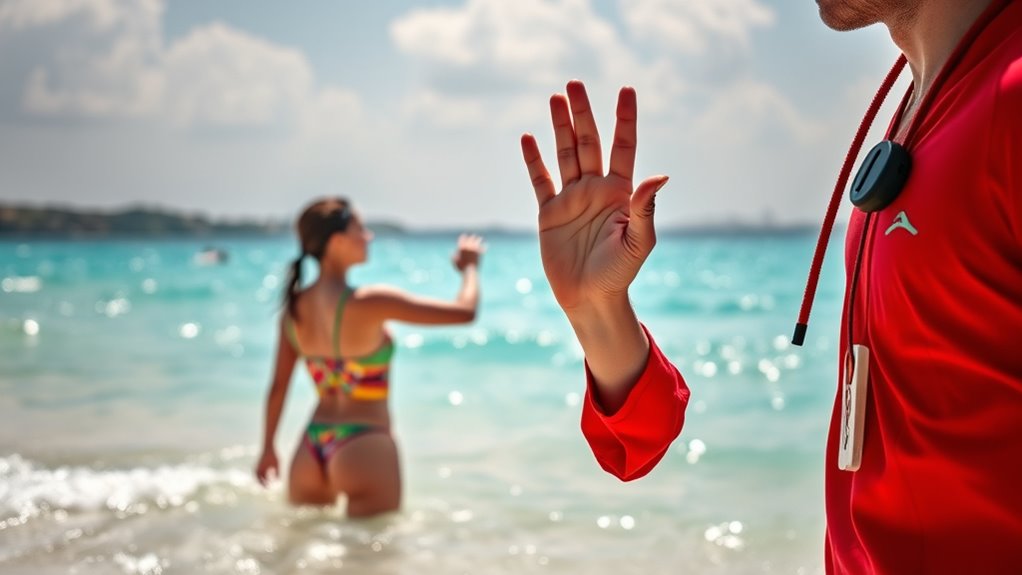
Have you ever wondered how lifeguards communicate quickly and effectively during emergencies? They rely on essential hand signals to convey critical information without words. For example, crossing both arms above your head signals a serious situation: a swimmer is missing and presumed submerged, needing immediate search and response. Touching the middle of the head with fingertips indicates the patient is stable but still under observation. Waving one arm in a circle above the head while the other stays parallel to the water means swimmers are in distress and need rescue. These signals must be repeated until acknowledged, ensuring clarity. Proper understanding of these signs is crucial before starting rescue activities, enabling lifeguards to coordinate swiftly and keep everyone safe during emergencies. Standardized signals are vital for clear communication and preventing misunderstandings in high-pressure situations.
As an affiliate, we earn on qualifying purchases.
Water Rescue and Emergency Signals
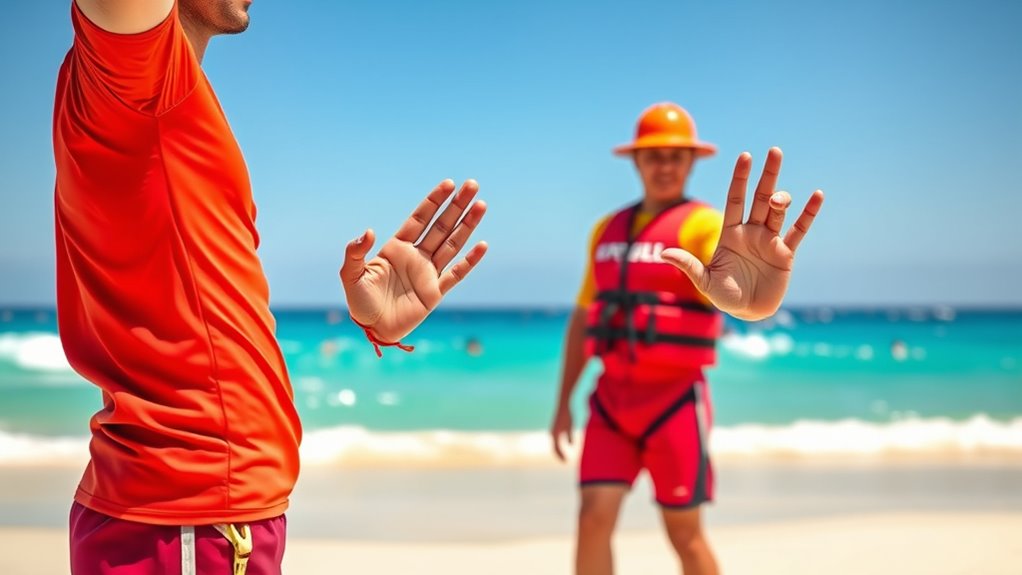
Water rescue and emergency signals are essential tools for lifeguards and rescue teams to communicate quickly and effectively during crises. When a swimmer is missing and presumed submerged, raising both arms above your head in a cross signals the need for an immediate search and rescue response. If someone needs assistance, raise one arm straight up to alert rescuers or support teams. During a resuscitation case, a rescuer waves their arm back and forth with the other arm straight, indicating victim incapacitation. To alert nearby lifeguards about swimmers in trouble, perform a circular wave with one arm above your head while keeping the other parallel to the water. Proper use of hand signals is fundamental for ensuring clear communication in emergency situations. Additionally, consistent and standardized gestures help prevent misinterpretation and delays during rescue efforts. Directional signals, like raising both arms vertically or pointing horizontally, instruct lifeguards to move further out to sea, toward shore, or laterally.
water safety whistle with hand signals
As an affiliate, we earn on qualifying purchases.
As an affiliate, we earn on qualifying purchases.
Communication Strategies for Water Safety Teams
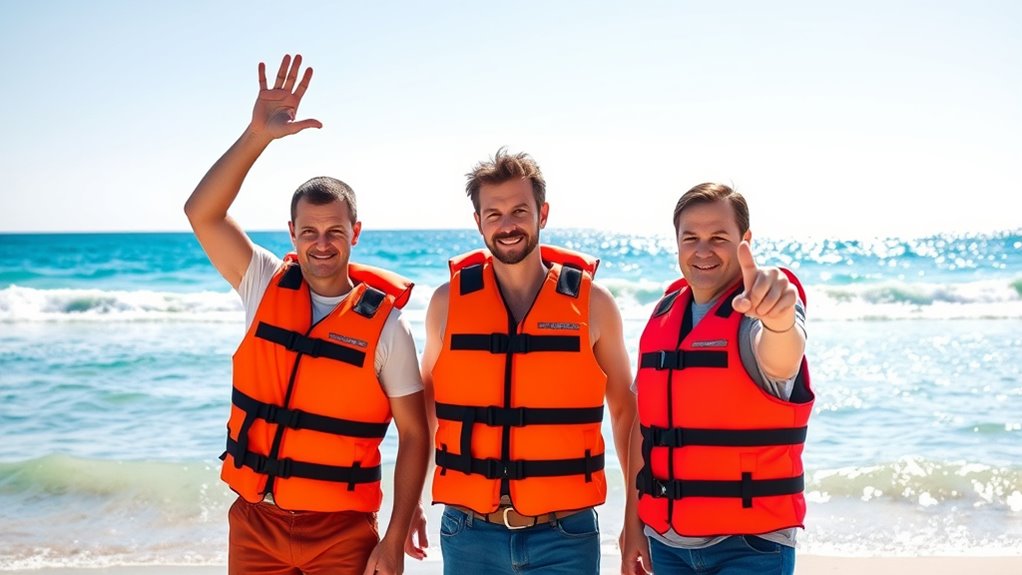
Effective communication is essential for water safety teams to coordinate quickly and respond efficiently during emergencies. You should use clear, simple instructions, avoiding jargon, and maintain a calm, confident tone to reinforce safety. Building trust through a friendly, empathetic approach helps reduce panic among swimmers. Employ tools like megaphones or radios to communicate over long distances or noisy environments. Incorporate nonverbal cues such as universal hand signals, flags, or flashing lights to alert swimmers of hazards. Use poolside communication boards with pictograms or multilingual signage to assist diverse patrons. Confirm messages through closed-loop techniques to prevent misunderstandings. Define roles clearly, foster active listening, and encourage feedback. Regularly test and train with backup systems to ensure seamless coordination during critical incidents.
international water rescue hand signals poster
As an affiliate, we earn on qualifying purchases.
As an affiliate, we earn on qualifying purchases.
Scuba Diving Hand Signals for Safe Exploration
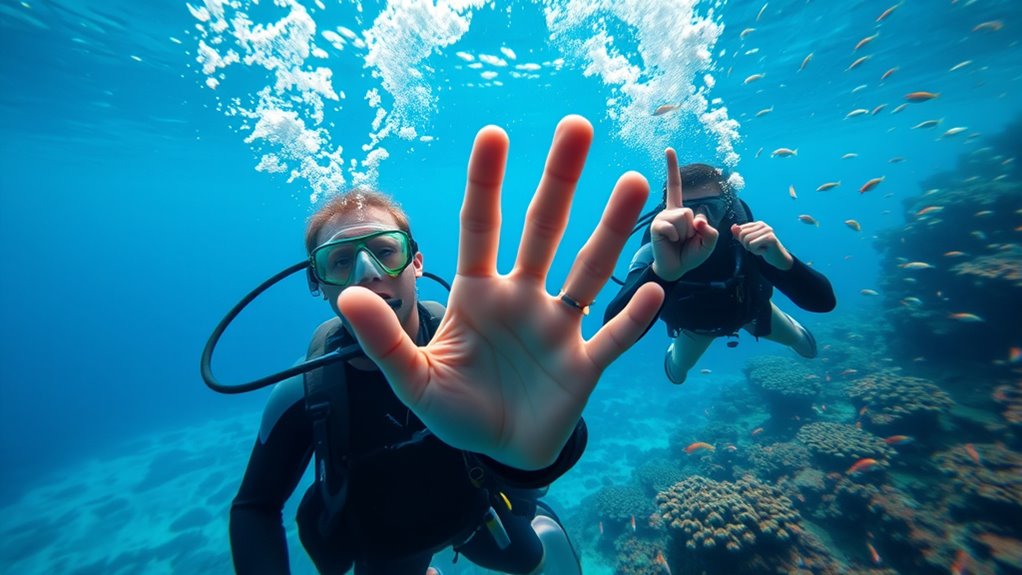
Mastering scuba diving hand signals is essential for safe exploration underwater because they enable clear communication when verbal words can’t be used. You’ll use finger and hand gestures to convey critical messages, such as air supply, direction, or emergencies. For example, the ‘OK’ sign confirms you’re fine, while a raised hand signals ‘Stop’. To indicate ascent or descent, you’ll use thumb movements. Communicating air levels might involve a curled finger for low air or a fist for crucial pressure. Here’s a quick reference:
| Signal | Meaning | Description |
|---|---|---|
| OK | All good | Circle with thumb and forefinger |
| Stop | Halt | Hand raised, palm out |
| Ascend | Go up | Thumb up motion |
| Out of air | Emergency | Wave hand in front of neck |
| Direction | Path | Point with fingers |
Recognizing and Responding to Distress Signals
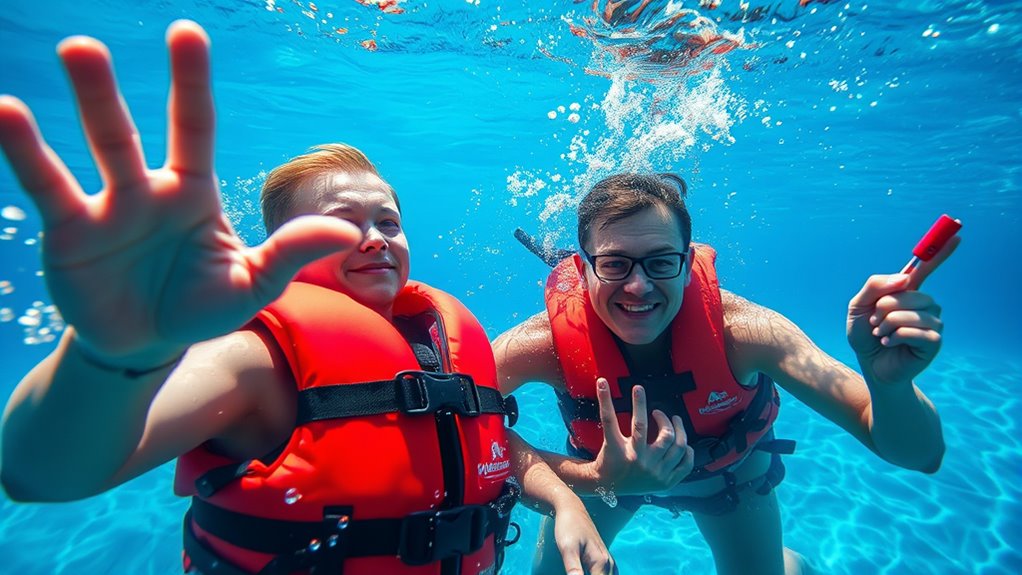
Recognizing distress signals quickly can make the difference between a successful rescue and a tragedy. When you see a swimmer with arms forming a cross overhead, it’s a critical call for help — a missing swimmer needing immediate rescue. Waving one arm in a circle with the other parallel to the water signals for rescue, while repeated, clear signals confirm the message. To coordinate effectively, use signals like raising one arm vertically to guide rescuers toward the person in need. Remember, deliberate gestures are essential; they prevent confusion during chaotic situations. Effective hand signals are universally understood and can be performed quickly to alert nearby boaters and rescuers. You should also be aware of these crucial signals:
- Waving one arm in a circle for help needed
- Raising an arm vertically to indicate where to go
- Using flat hand signals to stop or control rescue actions
Quick, clear responses ensure safety and save lives. Additionally, understanding the importance of visual clarity can improve communication during emergencies, especially in challenging weather or lighting conditions.
Frequently Asked Questions
How Do Hand Signals Differ Between Professional Lifeguards and Casual Swimmers?
You’ll notice professional lifeguards use standardized, precise hand signals to communicate quickly and clearly during rescues, like crossing arms or waving in circles. Casual swimmers, however, depend on simple, informal gestures such as waving an arm to signal distress. Their signals lack consistency and detail, making it harder for lifeguards to interpret emergencies accurately. This difference ensures professionals can coordinate effectively, while casual signals focus mainly on attracting attention.
Are There Regional Variations in International Water Safety Hand Signals?
You’ll find that regional variations in water safety hand signals are like different dialects in a shared language. While the core signals—like “help” or “all clear”—are generally understood worldwide, local agencies often tweak signals to fit their unique environments. These variations can be subtle or significant, so it’s essential to learn the specific signals used in each region. Always clarify with local lifeguards or dive guides to guarantee clear communication underwater or at the beach.
How Can Non-Verbal Communication Be Effective in Noisy or Crowded Water Environments?
You can make non-verbal communication effective in noisy or crowded water environments by using clear, large gestures that are easily seen from a distance. Focus on high-visibility positions like above the head or lateral arm extensions. Repeating signals ensures understanding, and maintaining eye contact confirms message receipt. Use standardized gestures so everyone interprets them the same way, reducing confusion and making sure quick, coordinated responses during emergencies.
What Training Is Recommended for Effective Use of Hand Signals in Emergencies?
Imagine yourself amidst choppy water, signals flying swiftly through the air. To use hand signals effectively in emergencies, you should undergo specialized training that emphasizes clear, standardized gestures recognized worldwide. Practice recognizing and executing critical signals like “Missing Swimmer” or “Help,” under pressure. Regular drills help you respond instinctively, ensuring your communication remains precise and quick, even in noisy or chaotic environments. This preparation boosts safety and coordination during real rescue situations.
How Do Hand Signals Accommodate Divers With Language Barriers or Disabilities?
You can communicate effectively with hand signals by using large, deliberate movements that are easy to see underwater, regardless of language barriers or disabilities. These signals rely on simple shapes and directional motions, making them universally understood. They also accommodate physical limitations by avoiding complex finger gestures and allowing for one- or two-handed use. Repeating signals clearly and combining them with visual cues guarantees everyone comprehends, even in low visibility or noisy environments.
Conclusion
Mastering these hand signals is like having a universal language that keeps everyone safe in the water. When you understand and use them confidently, you create a symphony of clear communication that can turn chaos into calm. Remember, your signals are the lifelines that connect you to others, helping you navigate emergencies and ensure everyone’s safety. Keep practicing, stay alert, and let these signals be the anchors that hold your water safety efforts steady.
Halloween Picks
halloween
As an affiliate, we earn on qualifying purchases.